Showing posts with label Collaborations. Show all posts

Monday, April 29, 2013

Giant Mesh Test

My friend/schoolmate Zia Zhu is an amazing modeler, and recently she was kind enough to lend me a ZBrush sculpt she did for use as a high-poly test model for Takua Render. The model is a sculpture of Venus, and is made up of slightly over a million quads, or about two million triangles once triangulated inside of Takua Render.

Here are some nice, pretty test renders I did. As usual, everything was rendered with Takua Render, and there has been absolutely zero post-processing:


Each one of these renders was lit using a single, large area light (with importance sampled direct lighting, of course). The material on the model is just standard lambert diffuse white; I'll do another set of test renders once I've finished rewriting my subsurface scatter system. Each render was set to 2800 samples per pixels and took about 20 minutes to render on a single GTX480. In other words, not spectacular, but not bad either.

The key takeaway from this series of tests was that Takua's performance still suffers significantly when datasets become extremely large; while the render took about 20 minutes, setup time (including memory transfer, etc) took nearly 5 minutes, which I'm not happy about. I'll be taking some time to rework Takua's memory manager.

On a happier note, KD-tree construction performed well! The KD-tree for the Venus sculpt was built out to a depth of 30 and took less than a second to build.

Here's a bonus image of what the sculpt looks like in the GL preview mode:


Again, all credit for the actual model goes to the incredibly talented Zia Zhu!

Monday, April 23, 2012

April 23rd CIS565 Progress Summary: Speed and Refraction


This post is the third update for the GPU Pathtracer project Peter and I are working on!

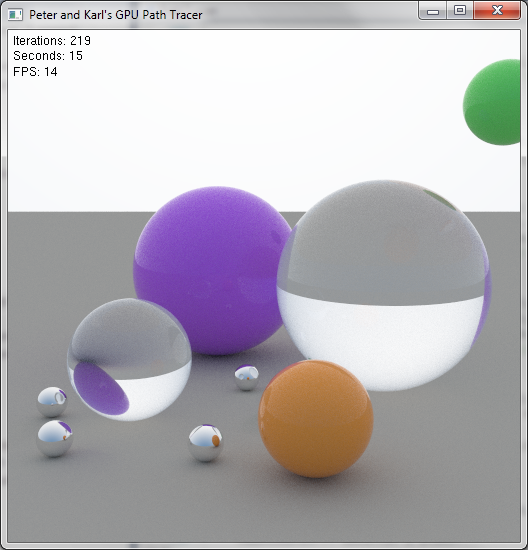
Over the past few weeks, the GPU Pathtracer has gained two huge improvements: refraction, and major speed  gains! In just 15 seconds on Peter's NVIDIA GTX530 (on a more powerful card in the lab, we get even better speeds) , we can now get something like this:


Admittedly Peter has been contributing more interesting code than I have, which makes sense since in this project Peter is clearly the veteran rendering expert and I am the newcomer. But, I am learning a lot, and Peter is getting more cool stuff done since I can get other stuff done and out of the way!

The posts for this update are:

1. Performance Optimization: Speed boosts through zero-weight ray elimination
2. Cool Error Render: Fun debug images from getting refraction to work
3. Transmission: Glass spheres!
4: Fast Convergence: Tricks for getting more raw speed

As always, check the posts for details and images!

Saturday, April 14, 2012

April 14th CIS563 Progress Summary: Meshes and Meshes and Meshes

This post is the second update for the MultiFluids project!

The past week for Dan and me has been all about meshes: mesh loading, mesh interactions, and mesh reconstruction! We integrated in a OBJ to Signed Distance Field convertor, which allowed us to then implement liquid-against-mesh interactions and use meshes to define starting liquid positions. We also figured out how to run marching cubes on signed distance fields, allowing us to export OBJ mesh sequences of our fluid simulation and bring our sims into Maya for rendering!

Here is a really cool render from this week:


The posts for this week are:

1. Surface Reconstruction via Marching Cubes: Level set goes in, OBJ comes out
2. Mesh Interactions: Using meshes as interactable objects
3. Meshes as Starting Liquid Volumes and Maya Integration: Cool tests with a liquid Stanford Dragon

Check out the posts for details, images, and videos!

Thursday, April 5, 2012

April 5th CIS565 Progress Summary: Interactivity, Alpha Review, Fresnel Reflections, Antialiasing

This post is the second update for the GPU Pathtracer project!

Since the last update, Peter and I added an interactive camera to the renderer to allow realtime movement around the scene! We also had our Alpha Review, which went quite well, and Peter implemented a reflection model. Initially the reflection model used was Schlick's Approximation, but later Peter replaced that with the full Fresnel equations. I also added super-sampled anti-aliasing for a smoother image.

The posts for this update:

1. Interactivity and Moveable Camera: We can move around the scene!
2. Alpha Review Presentation: Slides and other stuff from our Alpha Review
3. Specular Reflection Test: The first test with Shlick's Approximation
4. Fresnel Reflections: Some details on our reflection model
5. Abstract Art: Some fun buggy renders Peter produced while debugging
6. Anti-Aliasing: Super-sampled anti-aliasing!

A nice image from the last post:


Check the posts for tons of details, images, and even some video!

Sunday, April 1, 2012

April 1st CIS563 Progress Summary: Framework Improvements and Bounding Volumes

Here's the first progress update/blog digest for the MultiFluids project!

Dan and I started by taking our starting framework and tearing it down to its core. We then rebuilt the base code up with our own custom additions, leaving just the core solver intact. From there, we started building some of the basic features our project will require!

Here are the posts for this update:

1. Framework Improvements and Particles with Properties: Tearing the base code down to the ground and rebuilding it better, faster, and with more features
2. Bounding Volumes & Lesson 1: Don't just assume base code is perfect: Dan discovers some flaws in the base code!
3. Multiple Arbitrary Bounding Volumes: All-important object interaction

A frame from one of our test videos:

Check the posts for details and videos!

April 1st CIS565 Progress Summary: Camera and Pathtracing

Here's the first progress summary/blog digest for the GPU Pathtracer project!

Over the past few days, Peter and I established our framework, got random number generation working on the GPU, built an accumulator, figured out parallelized camera ray projection, got spherical intersection tests working, and got a basic path-traced image!

Here are the posts for this update:

1. Random Number Generation: Fun with parallelized random number generators and seeding
2. First Rays on the GPU: Parallel raycasting!
3. Accumulating Iterations: The heart of any monte-carlo based renderer
4. We Have Path Tracing: First working renders!

Here's an image from our very first working render! More soon!


Tuesday, March 27, 2012

CIS563/CIS565 Final Project Github Repos!


For both MultiFluids and the GPU Pathtracer, we will be making our source code accessibly to all on Github!

Of course commercial coding projects and whatnot have very good reasons for keeping their source code locked down and proprietary, but open source is something I very strongly believe in. Open code allows other people to see what one does and give feedback and suggestions for improvement, and also allows other people interested in similar projects to potentially learn and build off of. Everybody wins!

The MultiFluids repository can be found here: https://github.com/betajippity/MultiFluids

The GPU Pathtracer repository can be found here: https://github.com/peterkutz/GPUPathTracer/

Monday, March 19, 2012

CIS563/CIS565 Final Projects: Multiple Interacting Fluids and GPU Pathtracing

Over the next month and a half, I will be working on a pair of final projects for two of my classes, CIS565 (GPU Programming, taught by Patrick Cozzi), and CIS563 (Physically Based Animation, taught by Joe Kider).

For CIS563, I will be teaming up with my fellow classmate and good friend Dan Knowlton to develop a liquid fluid simulator capable of simulating multiple fluids interacting against each other. Dan is without a doubt one of the best in our class and easily my equal or superior in all things graphics, so working with him should be a lot of fun. Our project is going to be based primarily on the paper Multiple Interacting Fluids by Losasso et. al. and as a starting point we will be using Chris Batty's Fluid 3D framework.

For CIS565, I will be working with my fellow Pixarian and friend Peter Kutz, who is somewhat of a physically based rendering titan at Penn. Working with Peter should be a very interesting and exciting learning experience. Peter and I will be developing a CUDA based GPU Pathtracer with the goal of generating convincing photorealistic images extremely rapidly. We will be developing our GPU pathtracer from scratch, although we will obviously draw inspiration from both Peter's Photorealizer project and my own CPU pathtracer project.

For both projects, we will be keeping blogs where we will post development updates, so I won't post too much about development details to this here personal blog. Instead, I'm thinking about posting a weekly digest of progress on both projects with links to interesting highlights on the project blogs. 

Dan and I will be blogging at http://chocolatefudgesyrup.blogspot.com/. We've titled our project "Chocolate Syrup" for two reasons: firstly, Dan likes to codename his project with types of confectionaries, and secondly, chocolate syrup is one type of highly viscous fluid we aim for our simulator to be able to handle!

Peter and I will be blogging at http://gpupathtracer.blogspot.com/. For now we have decided to call our project "Peter and Karl's GPU Pathtracer", for obvious reasons. 

Details for each project can be found in the first post of each blog, which are the project proposals.


Both of these projects should be very very cool, and I'll be posting often to both development blogs!